Documentation Operating System Design
👥 Internal teams + AI agents 🎯 Scalable, consistent docs 📅 2026
Designed and implemented a documentation operating system that enables humans and AI agents to create, validate, and continuously improve high-quality docs through shared workflows, reusable architecture, and automated quality systems.
Problem
Documentation quality depended on individual writers. Engineering moved faster than docs, and contributors lacked shared workflows, and AI-generated content was inconsistent. Work bottle-necked at manual review, a process that didn’t scale with team velocity.
Solution
This system transformed documentation from a manual, writer-dependent process into a scalable system with built-in quality enforcement. Writers and agents follow a shared workflow, use structured templates, and are guided by a centralized style guide and terminology system. Automated tools validate output, catch inconsistencies, and keep terminology in sync, reducing review overhead and improving consistency across the docs.
At a glance
Internal teams and AI agents producing and maintaining documentation
Create a scalable system for producing consistently high-quality docs
Engineering, Growth, DevEx
Warp (agentic AI), Git, Python, internal tooling
System overview
The operating system treats docs as infrastructure rather than individual pages. Every contributor, whether human or agent, uses the same workflows, templates, terminology, and validation systems. The result is a platform that produces consistent output regardless of the author.
At a high level, the system combines:
- Structured templates for each content type (conceptual, procedural, quickstart, reference, and more), so authors start from a proven format rather than a blank page
- A shared drafting workflow that standardizes how content is researched, written, and reviewed
- A centralized style guide and terminology system that ensures consistency in voice, formatting, and product language
- Automated validation tools that check formatting, terminology, and UI references before content is merged
- Background synchronization processes that keep terminology aligned with upstream sources of truth
These components work together as a single pipeline: content is created using templates and workflows, validated automatically, and continuously kept in sync as the product evolves.
The result is a documentation system that scales with the product, reducing manual review, improving consistency, and enabling both humans and AI agents to contribute effectively.
System architecture
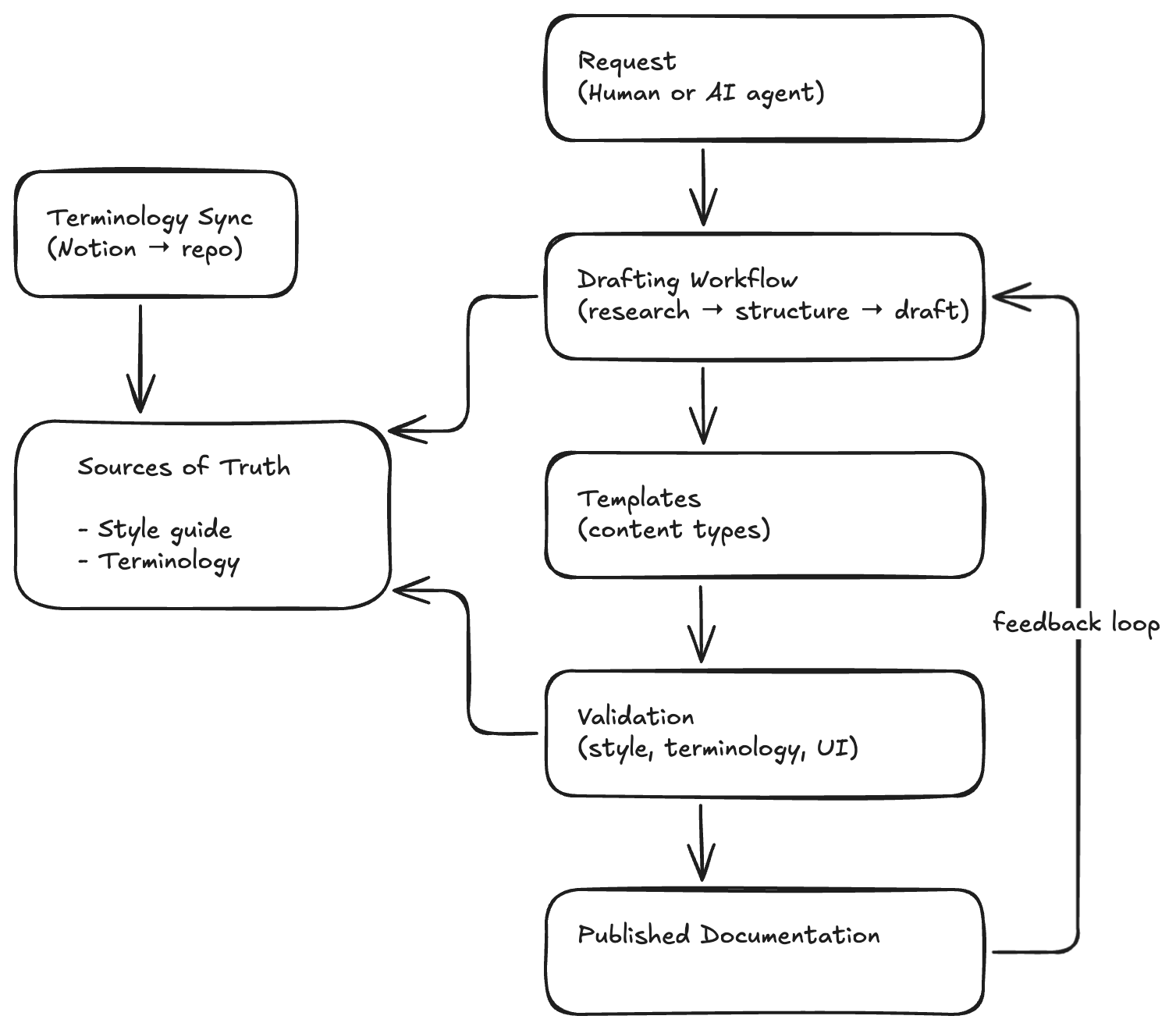
System components
-
Drafting workflow: A shared, repeatable process that guides every documentation update, including identifying the right content type, drafting, validating, and preparing changes for review.
-
Templates (content types): Structured Markdown templates for conceptual, procedural, quickstart, guides, and reference content. Each template embeds guidance so authors start with the right structure instead of a blank page.
-
Validation: Automated checks that enforce formatting, terminology, and UI accuracy before content is merged, reducing reliance on manual review.
-
Sources of truth: A centralized style guide and terminology glossary that define how documentation should be written, formatted, and named across the system.
-
Terminology sync: A background process that keeps the glossary aligned with an upstream source, ensuring consistent product language as the platform evolves.
-
Published documentation: The final output of the system: consistent, structured, and continuously maintained documentation that scales with both the product and the team.
📸 Browse the full system in Warp’s open-source docs repo.
Outcomes
- Enabled engineers and agents to contribute using shared workflows and embedded guidance.
- Reduced reliance on manual editorial review through continuous validation.
- Standardized docs architecture across the product.
- Improved terminology consistency through automated synchronization.
- Established a scalable foundation for autonomous docs improvement.
Design process
- Designed a content architecture based on content types (conceptual, procedural, quickstart, reference, etc.)
- Built reusable templates with embedded guidance to eliminate blank-page authoring
- Created a shared drafting workflow used across all documentation updates
- Developed automated validation tools (style linting, terminology checks, UI reference validation)
- Established a single source of truth for terminology with automated synchronization
- Enabled AI agents to participate in documentation workflows using the same system
Lessons learned
- Systems scale better than style guides
- AI works best when constrained by shared architecture
- Quality should be built into workflows rather than enforced afterward
Related projects
- Documentation Software Factory: how this operating system stays current through automated, continuously improving outer loops.
- Designing Agent-Friendly Documentation: the design principles that make this system’s output usable by AI agents.