Content System Design
Docs Content System – Warp
👥 Internal teams + AI agents 🎯 Scalable, consistent docs 📅 2026
Designed and implemented a docs-as-code content system that enables humans and AI agents to produce consistent, high-quality documentation through shared workflows, templates, and automated validation.
Impact
This system transformed documentation from a manual, writer-dependent process into a scalable system with built-in quality enforcement. Writers and agents follow a shared workflow, use structured templates, and are guided by a centralized style guide and terminology system. Automated tools validate output, catch inconsistencies, and keep terminology in sync, reducing review overhead and improving consistency across the docs.
At a glance
Internal teams and AI agents producing and maintaining documentation
Create a scalable system for producing consistently high-quality docs
Engineering, Growth, DevEx
Warp (agentic AI), Git, Python, internal tooling
System overview
The Warp documentation system is designed to make high-quality content reproducible, whether it’s written by a human or generated by an AI agent.
Instead of relying on individual writers to remember conventions, the system defines a shared structure for how documentation is created, validated, and maintained.
At a high level, the system combines:
- Structured templates for each content type (conceptual, procedural, quickstart, reference, and more), so authors start from a proven format rather than a blank page
- A shared drafting workflow that standardizes how content is researched, written, and reviewed
- A centralized style guide and terminology system that ensures consistency in voice, formatting, and product language
- Automated validation tools that check formatting, terminology, and UI references before content is merged
- Background synchronization processes that keep terminology aligned with upstream sources of truth
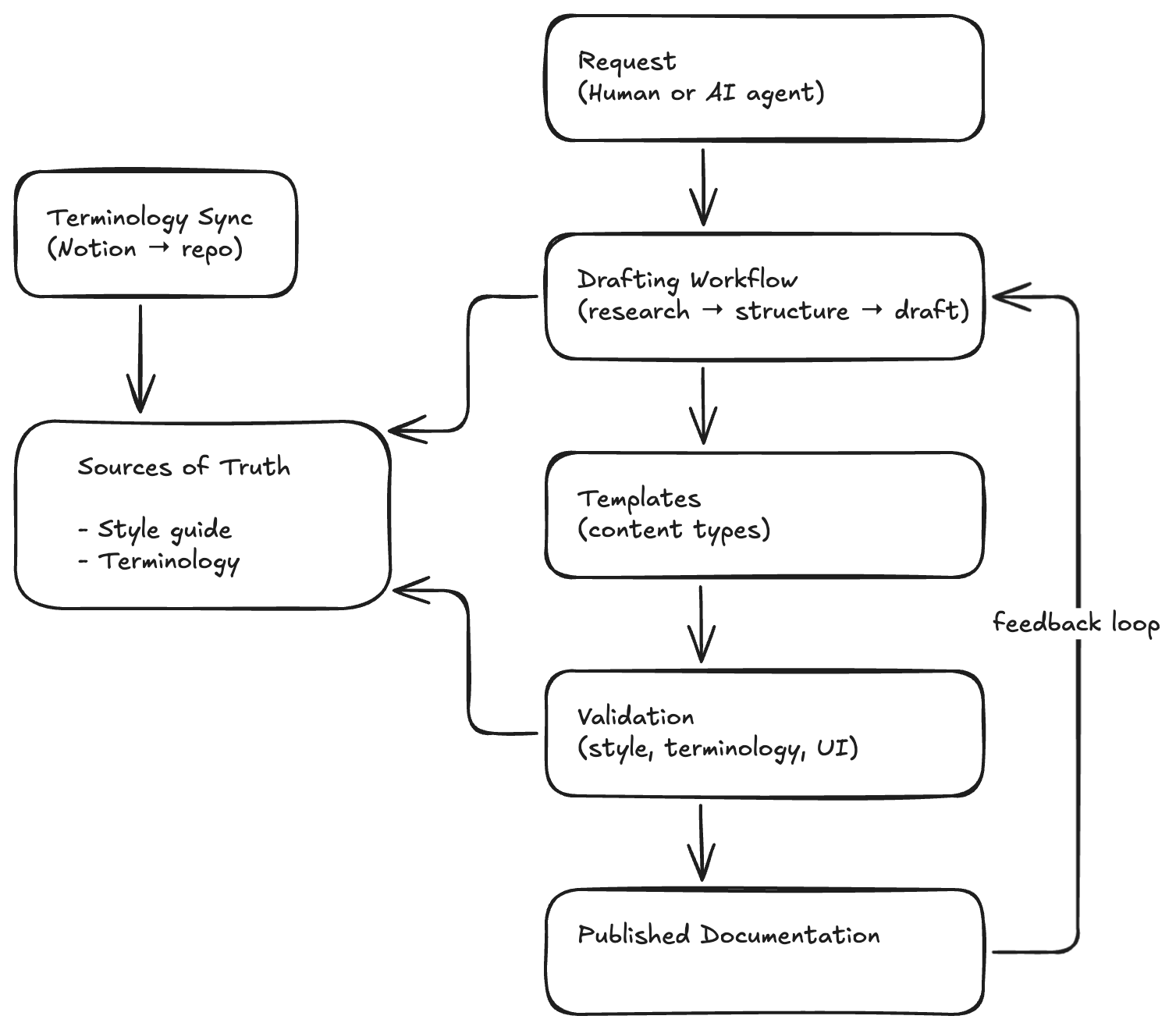
These components work together as a single pipeline: content is created using templates and workflows, validated automatically, and continuously kept in sync as the product evolves.
The result is a documentation system that scales with the product—reducing manual review, improving consistency, and enabling both humans and AI agents to contribute effectively.
System diagram
Key components
-
Drafting workflow: A shared, repeatable process that guides every documentation update, including identifying the right content type, drafting, validating, and preparing changes for review.
-
Templates (content types): Structured Markdown templates for conceptual, procedural, quickstart, guides, and reference content. Each template embeds guidance so authors start with the right structure instead of a blank page.
-
Validation: Automated checks that enforce formatting, terminology, and UI accuracy before content is merged, reducing reliance on manual review.
-
Sources of truth:A centralized style guide and terminology glossary that define how documentation should be written, formatted, and named across the system.
-
Terminology sync: A background process that keeps the glossary aligned with an upstream source, ensuring consistent product language as the platform evolves.
-
Published documentation: The final output of the system: consistent, structured, and continuously maintained documentation that scales with both the product and the team.
📸 View components live in Warp’s open-source docs repo.
Behind the work (click to expand)
Activities:
- Designed a content architecture based on content types (conceptual, procedural, quickstart, reference, etc.)
- Built reusable templates with embedded guidance to eliminate blank-page authoring
- Created a shared drafting workflow used across all documentation updates
- Developed automated validation tools (style linting, terminology checks, UI reference validation)
- Established a single source of truth for terminology with automated synchronization
- Enabled AI agents to participate in documentation workflows using the same system